
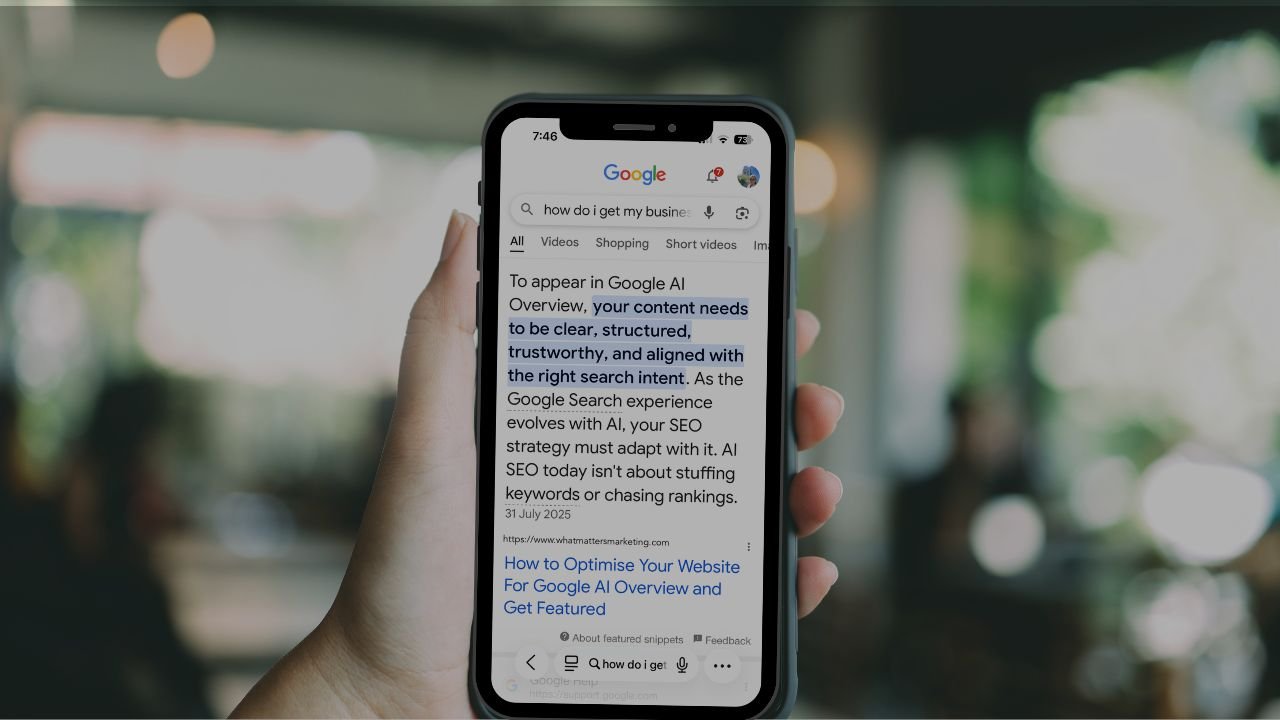
A Practical Guide for Small and Medium Businesses
Search is changing. Not just the way it looks – but the way people use it.
Thanks to the introduction of Google’s AI Overview and the rise of large language model platforms like ChatGPT, Claude, Gemini, and Perplexity, the traditional search experience is being fundamentally rewritten. Instead of clicking through ten blue links, users are now asking questions directly and getting AI-generated answers that pull from across the web to deliver a single, consolidated response.
For small and medium businesses, this shift is significant. It means your website is no longer just competing for a click. It’s competing to be the source an AI platform trusts enough to feature often before a user ever visits your site at all. That kind of visibility can be a serious competitive advantage, particularly for smaller businesses up against bigger players with larger marketing budgets.
While this guide focuses specifically on Google’s AI Overview and how your business can get featured – currently the most prominent AI-powered search feature – the principles here apply broadly. The steps that make your content trustworthy and well-structured enough for Google’s AI are largely the same ones that help you show up in ChatGPT, Perplexity, and the others too.
The good news? You don’t need to be a tech company or have a dedicated on-house SEO team to get there. This guide will give you a solid understanding of what these tools are looking for — and the knowledge to start making changes. But we also know that as a busy business owner, time is one thing you can’t afford to waste. The sooner your business is optimised for AI search, the sooner you’re not just keeping up with the competition – you’re ahead of it. Whether you work through this guide yourself or would like the team at What Matters Marketing to take care of it for you, the important thing is to act now.
This guide walks you through exactly how.
In This Guide
- First, Understand What Google’s AI Overview Actually Is
- Focus on Experience, Expertise, Authority, and Trust (E-E-A-T)
- Write Content That Answers Questions Completely
- Structure Your Content So AI Can Actually Read It
- Implement Structured Data and Schema Markup
- Target the Specific Questions People Are Actually Asking
- Make Sure Your Website Actually Works Well
- Build Backlinks from Credible Sources
- Keep Your Content Fresh and Monitor Your Performance
- Don’t Forget: Traditional SEO Still Underpins Everything
- A Quick-Action Checklist
- Frequently Asked Questions
Understand What Google’s AI Overview Actually Is
Google’s AI Overview isn’t a separate search engine or a new ranking system bolted on top of the existing one. It’s an extension of Google’s regular search – one that uses AI to pull relevant information from websites it already considers trustworthy and authoritative, and presents it as a concise summary at the top of the results page.
What that means for your business is straightforward: if Google already trusts your website and considers your content genuinely helpful, you’re already partway there. The AI Overview is pulling from the same pool of websites that Google ranks highly in traditional search. But it adds an extra layer – the content needs to be not just well-ranked, but also well-structured enough for AI to quickly extract and summarise.
So think of optimising for AI Overview as an extension of good SEO practice, not a completely separate discipline. The fundamentals still matter. But there are specific things you can do to increase your chances of being the source Google chooses to feature.
1. Focus on Experience, Expertise, Authority, and Trust (E-E-A-T)
This has been a cornerstone of Google’s content quality guidelines in more recent years and it matters even more when AI is the one deciding what to surface. Google updated its framework from E-A-T to E-E-A-T, adding “Experience” to the mix. That addition is significant, particularly for small business owners, because it means Google now actively rewards content written from firsthand experience and not just theoretical knowledge.
Google’s AI Overview favours content that feels credible and genuinely informed. That means your website needs to clearly demonstrate that you know what you’re talking about, and ideally, that you’ve lived it.
In practice, this looks like a few things. Write from your own experience where you can. If you’ve personally navigated a challenge your audience is facing, share that story. It’s one of the most compelling forms of authority a small business can offer, and it’s exactly the kind of content Google’s E-E-A-T framework is designed to reward. Make sure the information on your site is accurate and current as outdated or incorrect content will work against you. Back up claims with credible sources where relevant; a link to an industry report or a reference to established data adds weight.
Top Tip! The key question to ask yourself is: If a stranger landed on this page, would they trust the information here, and would they feel confident that it was written by someone who actually knows this space? If the answer is yes, you’re on the right track.
2. Write Content That Answers Questions Completely
AI Overviews are designed to give users a comprehensive answer in one place. That means Google is looking for content that covers a topic thoroughly — not just scratches the surface.
This doesn’t mean you need to write a 5,000-word essay on every topic. It means that when you do write about something, you should cover it from multiple angles. Include practical examples. Address the “why” as well as the “what.” Anticipate the follow-up questions a reader might have and answer those too.
For example, if you write a blog post titled “How to Choose the Right Accountant for a Small Business,” don’t just list what to look for. Talk about the questions you should ask during a consultation, the red flags to watch out for, how pricing typically works, and what the process looks like from start to finish. That kind of depth is what AI Overviews are built to surface.
A useful exercise: before you write, think about the five or six questions someone might ask Google about your topic. Then make sure your content answers all of them.
3. Structure Your Content So AI Can Actually Read It
This is one of the most overlooked steps — and one of the easiest to fix.
Google’s AI needs to quickly scan and summarise your content. If your page is a wall of unbroken text, that’s significantly harder. A clear, logical structure makes it easy for both AI and human readers to find the information they need.
Use headings (H1, H2, H3) to break your content into distinct sections, with each heading clearly signalling what that section covers. Use numbered lists when you’re walking someone through a process — they’re easier to parse than paragraphs. Use bullet points for key takeaways or comparisons. And use tables when you’re presenting information that naturally falls into categories, like a comparison of options or a summary of features.
This isn’t just good writing practice. It’s one of the clearest signals you can give Google that your content is well-organised, easy to navigate, and worth featuring.
4. Implement Structured Data and Schema Markup
If you’ve heard the term “schema markup” and immediately felt your eyes glaze over, you’re not alone. But this is genuinely one of the most impactful things you can do for AI Overview visibility — and it’s not as complicated as it sounds.
Schema markup is a piece of code you add to your website that tells Google (and other search engines) exactly what your content is about in a way machines can understand. It’s like adding labels to a filing cabinet — it helps Google categorise and use your information more effectively.
For small businesses, the most useful types of schema include FAQ schema (if your page answers common questions), HowTo schema (if you’re creating step-by-step guides), and LocalBusiness schema (if you want Google to understand your business type, location, and what you offer).
You can test whether your schema is working correctly using Google’s free Rich Results Test tool. If something isn’t set up right, it’ll tell you exactly what needs fixing. For most WordPress sites, there are plugins that handle the heavy lifting — you don’t need to write code yourself.
5. Target the Specific Questions People Are Actually Asking
Generic, broad keywords are increasingly less effective — both for traditional SEO and for AI Overview visibility. What works better is targeting the specific, conversational questions that real people are typing into Google (or asking AI tools directly).
Instead of writing content optimised for a broad term like “business insurance,” write content that answers a specific question: “What type of business insurance do I actually need if I run a sole trader consultancy?” That level of specificity is exactly what AI Overviews are designed to surface.
Finding these questions doesn’t require expensive tools. Start with Google’s own “People Also Ask” section — it shows you the follow-up questions real users are asking. Tools like AnswerThePublic and AlsoAsked are also free or low-cost and can generate a useful list of question-based search queries around any topic.
Once you have your questions, build content around them. A dedicated FAQ section at the bottom of a relevant page works well. So does a standalone blog post structured around a single question with a clear, direct answer near the top.
6. Make Sure Your Website Actually Works Well
Google’s AI doesn’t just look at your content in isolation. It also considers how users experience your website, and a poor user experience is a signal that your site isn’t worth featuring.
A website that people enjoy using is a website Google is more likely to trust, and more likely to feature.
7. Build Backlinks from Credible Sources
Backlinks — links from other websites pointing to yours — have always been one of Google’s strongest trust signals. That hasn’t changed with AI Overviews. If anything, it’s become more important.
A website that other credible sources are linking to feels more authoritative than one that exists in isolation. And for small businesses, building backlinks doesn’t have to mean cold-emailing journalists or paying for link placements.
Some practical approaches that work well for SMEs: write genuinely useful blog posts that other people in your industry would want to share or reference. Create a free tool, template, or resource that adds real value — even something simple can attract links if it solves a specific problem. Collaborate with complementary businesses or industry groups on guides or content. And if you have relationships with other business owners, ask if there are opportunities to contribute a guest post or be quoted as an expert.
Each credible link is another vote of confidence in your website — and another signal to Google that your content is worth featuring.
8. Keep Your Content Fresh and Monitor Your Performance
Getting featured in an AI Overview isn’t a one-time achievement. Google updates what it displays regularly, and content that was featured last month might not be featured next month if something better comes along.
This means you need to treat your content as a living thing. Revisit older posts periodically and update them if the information has changed or if there are new angles worth covering. Check Google Search Console to see how your question-based content is performing in terms of impressions and clicks — this tells you whether Google is finding your content relevant to the queries you’re targeting.
If you’re not already using Search Console, set it up. It’s free, it’s owned by Google, and it gives you direct insight into how Google sees your site. For tracking broader keyword performance over time, tools like Ahrefs or SEMrush can be useful — though they’re not strictly necessary to get started.
The businesses that do well in AI Overviews long-term aren’t the ones that optimise once and walk away. They’re the ones that keep improving, keep updating, and keep paying attention to what Google is actually rewarding.
9. Don’t Forget: Traditional SEO Still Underpins Everything
It’s worth saying clearly: Google’s AI Overview is not a replacement for traditional SEO. It builds on top of it. The websites that get featured in AI Overviews are, overwhelmingly, the same websites that already perform well in regular Google search.
That means every piece of SEO fundamentals still applies — your page titles, meta descriptions, internal linking, technical health, mobile optimisation, and content quality all still matter. AI Overview optimisation isn’t a shortcut around good SEO. It’s an additional layer of opportunity for businesses that have already done the foundational work well.
If your SEO fundamentals aren’t solid, start there before worrying about AI Overviews specifically. Get the basics right, and the AI visibility will follow.
A Quick-Action Checklist
If you want to get started without feeling overwhelmed, here’s where to focus first in roughly the order of impact:
- Audit your existing content. Pick your top five pages and ask: does this content answer a specific question completely? Is it structured with clear headings and logical flow?
- Check your site’s technical health. Run PageSpeed Insights on your key pages. Make sure your site is mobile-responsive.
- Add schema markup. Start with FAQ or LocalBusiness schema using a free plugin or tool. Test it with Rich Results Test.
- Identify the questions your audience is asking. Use People Also Ask or AnswerThePublic. Build or update content around those questions.
- Add a FAQ section to your most relevant pages, even just three or four questions and answers.
- Work on one backlink. Write a useful blog post, create a shareable resource, or reach out to a complementary business about a collaboration.
- Set up Google Search Console if you haven’t already. Start tracking how your content is performing.
- Revisit this list in a month. Pick one more thing to improve. Consistency beats perfection every time.
FAQs
Does Google’s AI Overview replace traditional search rankings?
How long does it take to get featured in an AI Overview?
Do I need to pay Google or use any special tools to be included?
Is schema markup really necessary, or is it optional?
What if my business is very small or very niche? Can I still get featured?
How do I know if my content is actually being picked up by AI Overview?
Should I write my content differently now that AI is involved?
The Bottom Line
Google’s AI Overview is becoming an increasingly important part of how people find information online — and how businesses get seen. But it’s not a mysterious black box that only the biggest companies can crack.
The businesses that get featured are the ones that write genuinely helpful content, structure it clearly, demonstrate real expertise, and build credibility over time. Those are the same things that have always made good marketing and good SEO — AI Overviews just raise the stakes a little.
You can absolutely take a DIY approach — start with the fundamentals, be consistent, and keep improving. Small, intentional steps taken regularly can cover a lot of ground. However, if you want to ensure the technical aspects and best practices are handled correctly to give your business the best possible chance at success with AI visibility and Google AI Overviews, What Matters Marketing can review your current setup and identify the opportunities that matter most.


